| In the motivation section of this series about poverty we take a Machiavellian viewpoint and consider why business leaders should take an interest in tackling poverty and where is the return on investment. |
At what point does employment become exploitation? How can you tell if you are treating someone fairly? These questions are not easy to answer.
Some people point at the living wage - the best baseline we have for fair wages. However, it’s not as simple as money. Not all workers have the power to demand the wage they need. Other workers can set a higher benchmark for their standard of living and have the power to demand it.
The phrase “make work pay” must not be just a political slogan used to grease the wheels of social benefit reform[1], it must be a fundamental truth about our job market.
Anecdote
After my parents split we spent 2 years living in temporary social housing, before moving into a council house in 1987.
My step dad was a skilled carpenter but had no formal qualifications. By the time we moved in with him he worked in a factory as an unskilled labourer and lost his job in 1989, in the early stages of the recession that blighted the 1990s.
When the recession ended unskilled factory work was difficult to find, especially for a man in his fifties with many younger men vying for the same jobs. Over the next few years our family got by on my mom’s cleaner’s salary.
1990 saw the introduction of the community charge, better known as The Poll Tax. The new tax replaced the “rates” system that was based on the value of each house. The Poll Tax was a flat rate - everyone paid the same amount of tax, whether you were a company director or a cleaner.
In the first months of 1990 I saw many news items that explained how the tax would work and how much it would would cost. A few weeks before the tax was introduced, the news was dominated by the non-payment protests and, soon after, coverage of the riots.
While watching the news one evening a huge argument erupted between my mom and my step dad. My parents had the usual domestic arguments about smoking habits or what to eat for dinner. However, this argument was different; it was more passionate and raw.
“We don’t have that kind of money,” exclaimed my step dad.
“Well, what you gonna do? They’re sending people to prison,” said mom, referring to the news item we had just watched.
“There’s no other way, you’ll have to leave your job.”
“No!” screamed mom, “I’ve always paid my way. I’m not living on fucking benefits!”
Mom stormed out of the living room, slamming the door behind her.
Of all the adversity we’d been through, I had never seen my mom so stressed and angry.
There was a caveat in the poll tax: the unemployed paid only 20%. If both my parents were out of work we would have the council house practically rent free and the poll tax would be greatly reduced.
We couldn’t afford to pay the poll tax with my mom working. My parents were better off unemployed.
I didn’t sleep well that night. I was twelve and old enough to understand the problem. I had seen news reports of the riots and the first people to be prosecuted for non-payment. I also knew the struggles my parents were going through. Our lifestyle was basic but had become even more austere since my step dad lost his job.
Lying in bed I thought about the consequences. Would both my mom and step dad go to prison? We would obviously be kicked out of the house for non-payment. I pictured our possessions in the street. Would we create a make-shift shelter on the pavement in front of our house, or would we de-camp to the local park?
I suspect my parents had similar thoughts running through their heads. Their thoughts may not have been so childish in their imagery, however, when faced with an impossible problem adults often clutch at straws and arrive at bizarre, childish conclusions.
Thousands of people across the UK faced the same impossible problem created by the poll tax.
Discussion
Exploitation is the point at which employing a person becomes un-sustainable. Any job must pay enough money for the person to survive, continue to turn up at work and perform their tasks.
If you are going to exploit a section of society you need to make it sustainable to ensure it is cost effective.
For example, the public purse invests heavily in raising children - in the form of free education and child benefits. If we exploit young people as they enter the job market and drive them into an early grave then society does not reap a sufficient ROI to pay off that debt.
This is the barrier the Conservative Party always hit, when they cut benefits to drive people into low wage jobs. The result is more people pushed down into poverty to the point of homelessness. The centre-right have to sweep in and remind the far right that killing the poor is not good for business.
Government benefits mask this problem by topping-up low income households. Socialism steps in where (irresponsible) capitalism has failed.
In the previous article, “rewarding contribution”, we looked at how salaries are capped and not reflective of performance or contribution.
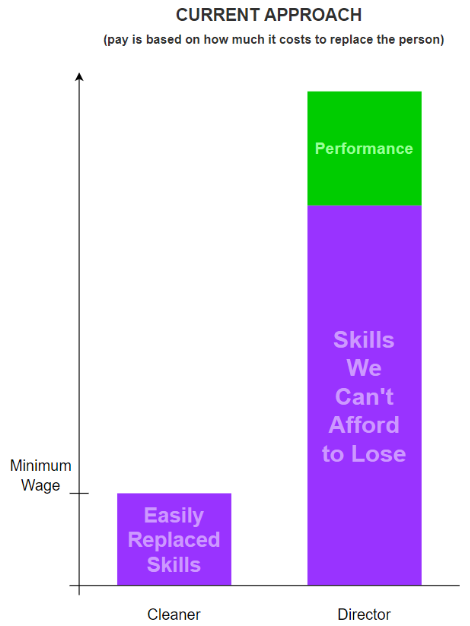
Most salaries are based on replaceability - how easily can you sack and replace a given worker.
This is a perfectly rational approach; we are simply offsetting risk but it is an approach based on fear - the fear of how the company may cease to function without specific people who know how parts of the company work.
Some staff are seen as essential and impossible to replace, while other people are non-essential. We should remind ourselves at this point of the “essential workers” who were asked to continue working during the COVID-19 pandemic. It was amusing (or should I say bemusing) to see that many essential workers - nurses, cleaners, delivery drivers, repair and construction workers - were people earning below average wage. A clear indicator that an “essential role” and an “easy to replace person” are not mutually exclusive concepts.
The pay for staff who are “impossible to replace” has reached irrational levels. Like a stock market bubble that has got out of control. We have entered into a mass delusion but we are too scared of the consequences of bursting the bubble.
While different jobs with different skills should have different pay grades, no one should have to fill a specific role to achieve a living wage.
A working-class person should be paid just as much for their time as a middle-class person fulfilling a “more important” job. In addition to being paid for their time, a person should be paid for their skills (their “value-add”) and their performance.
The concept of guaranteed minimum income (GDI) is not new but it is often misunderstood. People tend to see it as a call for a giant leap in the minimum wage. It is wrongly seen as a high minimum bar. The reality is a small increase in minimum wage and a wide-range in pay scale, as shown below.
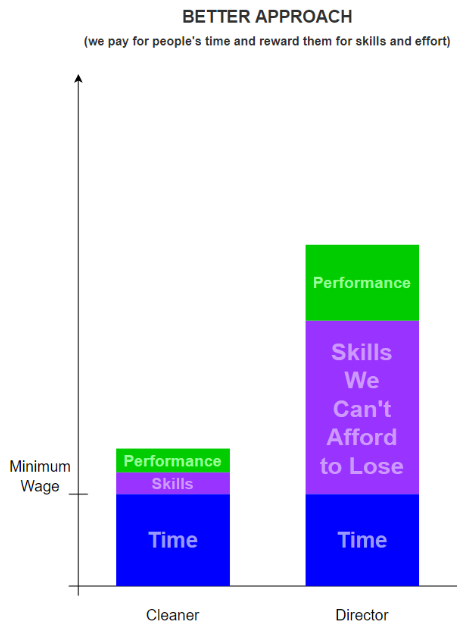
There is a baseline to wages. It’s the living wage, not the minimum wage.
Below this a person’s ability to pay for their own up-keep tails off to exploitation and death. The economy relies on a new generation of people coming forward to replace the exploited. This is why we often don’t notice exploitation - there is a conveyor belt of working class people coming through the system to replace those who die early.
Summary
Where do you draw the line? Are you prepared to pay a minimum, living wage? Are you prepared to offer benefits to support families whose income does not meet the cost of living? Are you prepared to evict children to the street, rather than provide social housing? Ultimately, are you prepared to terminate the poor?
No sane person would kill children in need. So the question is: at what stage do you help?
Anyone who sneers at socialism’s higher ideals must be prepared to follow through on the ugly side of fascism, otherwise you are just putting off tackling the issue until it has escalated to a critical stage.
As shown with the poll tax, it’s not possible to beat someone out of poverty. Even harsh right-wing policies eventually meet with concessions for the poor because no one is prepared to take that last step and allow the poor to die. It’s bad for business and bad for re-election campaigns.
Poverty is like obesity: if left to fester it reaches a morbid state and creates a crisis point. Unless you are prepared to terminate the subject, you should tackle the problem as early as possible.
[1]
A slogan that is rolled out time, time and time again.