| In the motivation section of this series about poverty we take a Machiavellian viewpoint and consider why business leaders should take an interest in tackling poverty and where is the return on investment. |
Working relationships can be as complex and subtle as our personal relationships. Although a company’s structure designates seniority, who commands and who obeys, the fact is that all relationships require give and take. Only a complete totalitarian moron would believe otherwise.
When the executive team in a company decide upon salary structure and when the managerial team distribute pay rises they often fall into the misconception that a person who accepted less last time will continue to accept less again and again.
This is a fallacy. Everyone has their breaking point.
Anecdote
While at university I took part in a weekly pub quiz at my local boozer. The quiz was run by the Quiz Master and a DJ who played samples for any music questions and kept us entertained between each round.
One night, after the quiz had finished, I came back from the bar to find the quiz master and DJ having a flaming row.
“It’s not good enough,” shouted the quiz master, “Too many mistakes, I won’t put up with it.”
The DJ said nothing. He calmly packed away his kit, loaded it onto a trolley and started wheeling the stuff out to the car park. The quiz master walked alongside the DJ and continued shouting into his ear.
“It’s my quiz! It’s my name on the poster! I won’t have you making me look stupid.”
I tried to recall what had gone wrong. There was no error in the music round. Perhaps it was the choice of music played between rounds.
The following week I walked to the pub with a sense of apprehension. Had the DJ and quiz master resolved their differences? Would the row last week all be forgotten, or would the quiz master have a new DJ?
I walked in and saw the DJ sitting behind his decks.
“Ah, I see you’ve made up,” I said.
“No,” he replied, “I couldn’t accept him talking to me like that. He’s gone.”
“He has gone? But he’s the quiz master, it’s his quiz.”
“Yeah, but it’s my mic he spoke into, my speakers his voice came out of, my music that plays from my decks. All he does is pull questions from a library of quiz books and read them out. I can do that myself.”
It took a few seconds for this answer to sink in. I needed to back out of a mental tunnel that I had trapped myself inside.
Yes, it was the quiz master’s name on the poster. Everyone regarded the quiz as his. Our respect and recognition made the quiz master think he was in total control when in fact he was 100% replaceable.
As much as the quiz master had deluded himself, I had been part of the delusion too. I had totally bought into the mindset that one person was master and commander.
Discussion
Most people in power realise they are part of a team. They take credit for leading the team but are aware that any achievement is accomplished by the whole team. You see this regularly in award ceremonies, when a figurehead accepts an award on behalf of their team and makes a speech that acknowledges “the people who made this possible”.
When the leader earns 100 times more than the average wage, you have to wonder if this team ethic is being respected or abused. There are limits to sharing wealth in a one-sided manner.
The Ultimatum Game was invented for a branch of mathematics called game theory but has been studied in economics to understand the psychology of negotiating deals.
The game is a simple exercise in sharing money between two people. One person is the proposer and chooses how a pot of money is split. The other player is the responder and chooses whether to accept or reject the offer. If rejected, both players get nothing.
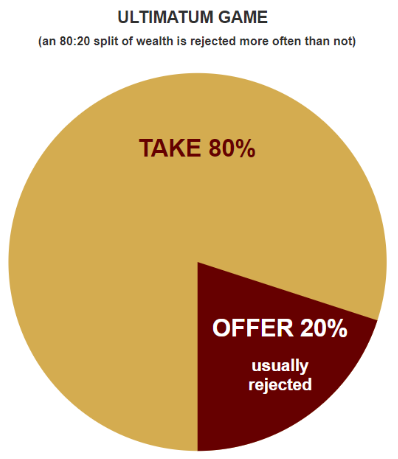
Research shows that when the proposer offers 20% or less, the offer is rejected more than accepted.
Remembering that both players receive nothing when the offer is rejected, this leads some to call this outcome “irrational”. Why would the responder reject some money - a 20% split, say - and prefer to receive no money at all?
The answer is self esteem. Scientists formally call this “inequity aversion” and “the perception of unfairness” in their their research papers. Everybody has a sense of worth and we do not like to be demeaned, especially when the person delivering the put-down has no right to look down on us.
Variations of this game have been tried, researched and analysed: what happens when there are several rounds of the same game with the same players - do responders reject a low offer to force a better offer in subsequent rounds; what happens when the proposer has the chance to reason with the responder and set expectations for a really low split?
There is a huge amount of psychology involved in such a simple game. The bottom line is that offers below 20% are usually challenged.
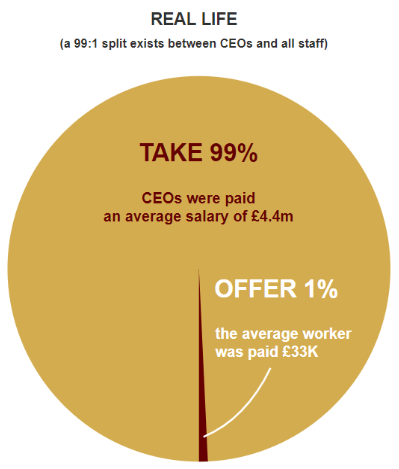
In 2022 The High Pay Centre reported that the UK’s top CEOs were paid an average of £4.4m. At the same time the average salary in the UK was £33K.
We appear to be in a society where offers of 1% are being routinely accepted. How can this be? Research shows that offers of 1% should be universally rejected.
Firstly, the Ultimatum Game is contested between just two people, who both know how much money each other will receive. In salary negotiations the pot is split between all employees in an organisation and, importantly, people usually don’t know the salaries of their colleagues.
Secondly, there is a more at stake when considering whether to accept a salary offer. Walking away with nothing has an impact on your family, not just your own finances.
However, when low wages reach a point where they impact a person’s family, this is the point at which people can justify not accepting the salary offered. If people walk away from jobs that do not pay a living wage that is when control is lost and both sides end the game with nothing.
Summary
People delude themselves and those around them into believing they are in a position of power when they have authority and command.
- You may have your name on the poster, but it's not your quiz.
- You may make executive decisions, but it's not your company.
- You may be living in 10 Downing Street, but it's not your country.
The reality is that all other people are contributing and it's a partnership. Regardless of how high you ascend, you must keep yourself grounded and work as a partnership, not as an authoritarian who is entitled to extraordinary privileges.
In the past our political leaders have understood the need to keep grounded, although in recent years it’s a skill that has waned. In contrast, people who float into the upper echelons of big business have felt less inclined to keep in touch with the reality of ordinary life.
As the worlds of business and politics come ever closer together, I sadly see a trend towards fascism and a chronic case of ivory-tower syndrome.
Final Anecdote
I want to end this series of articles with a positive message about responsible capitalism. While greed and capitalism are often mentioned in the same breath, they do not have to go hand-in-hand with each other.
In 2006 I joined a small, privately owned company.
My previous job had been at a medium sized, public limited company. They held an annual general meeting which was split over several days at multiple town hall meetings lead by the CEO. At my new company everyone fit into one meeting room. The AGM was far more personal.
The founder and owner of the business presented the company figures: turnover, EBIT and profit. The company had made £500K profit that year; an amazing result for a small company.
The boss was proud of our success, appreciated our hard work and committed most of that profit to fund improvements within the company. He would take a £100K dividend but the rest would be invested back into the company.
A murmur went through the room as he announced this. He seemed embarrassed for taking the dividend and felt compelled to point out that he had a negligible salary and only takes a significant financial reward if the company turns a profit.
I appreciated the honesty but it was unnecessary. He founded the company, he built it from scratch. He employed around 30 people, all of whom were earning above minimum wage. He payed his staff well, treated them with respect and appreciated their contribution. He brought well-paid jobs into our society and deserved whatever spoils came from his ventures.
This is how responsible capitalism should work and can work.
Our society is suffering from greed. The answer is not mindless revolution, we need intelligent evolution.