| In the motivation section of this series about poverty we take a Machiavellian viewpoint and consider why business leaders should take an interest in tackling poverty and where is the return on investment. |
One of the fundamentals of economics is using pay to balance the job market. Higher wages encourage people to retrain, swap their redundant skills for desirable skills, attract talent into our companies and reward good work.
We like to think we reward people for their performance and contribution towards the company’s objectives. This is true for some but it’s not the reality for most workers.
Anecdote
My Dad was a Power Press Toolsetter, working in a factory that supplied car parts to Rover.
Power presses are huge machines ranging from 20 to 200 tonnes, the largest are the size of a semi detached house. They have four stations where operators stand. Each operator moves a component into position before closing the safety guard and hitting the ready button. When all four stations are ready the press comes down and presses the components into shape.
Dad’s factory was relatively small, just a dozen power presses in each of the two production lines. While one production line was live Dad set up the other line for the next job. He would climb into the machine, disassemble and reassemble the tool which cut and moulded the component, then run components through the machine to check the output matched the documented specification.
A new foreman arrived at Dad’s factory who was somewhat of a control freak.
At precisely 10:30 each morning the foreman would walk into the kitchen to find a queue of men at the sink.
“What are you doing?” he shouted, “It’s 10:30! Your break is over. You shouldn’t be washing up your mug, you should be out on the shop floor.”
“Yeah, mate. Be right there,” came the unconcerned reply.
One morning, Dad’s mate Hal was feeling unwell. At 10:32 the foreman was frantically buzzing around the factory floor.
“Where’s Hal? Has anybody seen Hal?”
“I think he’s still in the loo. He’s not feeling very well.”
The foreman marched into the toilets, saw one of the cubicles was engaged, went up and knocked on the cubicle door.
“Hal! Hal! Is that you in there?”
“Yeah?”
“... Well… What do you think you’re doing?”
“I’m having a dump! … Do you want me to draw you a diagram?”
When Dad recounted this story to me I thought he was passing on a funny anecdote. As a young teenager I didn’t notice I was gaining an understanding of workplace attitudes and the relationship between worker and manager. I couldn’t have realised at that time how important this would be.
Years later, during my time at university, I had a summer job working as a domestic at Birmingham’s Women’s Hospital. I was told I couldn’t work on the wards because there were women breast feeding. The only areas I could clean were the outpatients department, the admin offices and the school of nursing. I preferred the latter. I got to team up with my friend Lisa.
The school of nursing was a separate building, a short walk down the road. Our timesheet allotted us 5 minutes to walk in each direction. In reality the walk only took 2 minutes so Lisa and I reallocated the unused time as a tea break in the middle of our shift.
One evening we were standing in the narrow kitchenette chatting when Lisa performed one of the most extraordinary physical feats I have ever witnessed. In one swift motion she put down a full mug of tea, picked up a cloth from the table and started wiping the wall - without a drop of tea leaving the mug.
“What’s this? Have you finished early?” came a voice from behind me.
It was our manager, dropping in to see what we were doing and angry that we were not working.
“No,” I said, looking over my shoulder, “we’re half way through.”
It wasn’t met with a response. Our manager directed her anger at Lisa. Lisa was the more experienced worker who, seemingly, was leading me astray. I was ushered out of the room and back to work while Lisa got a thorough dressing down.
Not for one moment did I take this reprimand seriously. If I had been given chance to continue I would have told the plain truth…
“It’s going great. We arrived 3 minutes early. We didn’t stand at the door waiting for 5-past, like the timesheet mandates, we cracked on. We emptied the bins, cleaned the toilets, I vacuumed the library downstairs while Lisa did the offices upstarts. We were ahead of schedule, the remaining work is all in-hand, so we stopped for a cuppa.”
My dad’s story shaped my attitude to work. To work hard, be honest, give respect and expect respect in return.
My remaining time that summer was spent cleaning the admin offices. I didn’t work with Lisa again.
Discussion
Working class people are not allowed to manage their time, assess progress towards their goals and choose when to take a break.
Since leaving university I have spent 25 years working in an office and every time I choose to take a tea break I remind myself of my privilege.
Harv Eker’s book Secrets of the Millionaire Mind makes some very good observations about the differences between poor and rich people. However, it fails to register that poor people are trapped in their mindsets by a lack of money, power and personal autonomy.
The specific example “poor people choose to get paid based on time; rich people choose to get paid based on results” is far from the truth. In reality, workers in low paid jobs do not have a choice and millionaires do not choose to be paid by results.
CEOs’ pay is not linked to performance. Even Nationwide, one of the more ethical banking organisations, chose to increase their directors’ salaries in 2014 because the performance-related bonuses had been missed several times due to the global financial crisis. One example of rich people choosing to get paid based on time because getting paid based on results has not paid off.[1]
We like to think that pay is based on a combination of performance and the added value an individual brings to the business through their skillset. We pretend that performance is important and should be reflected in a person’s salary:
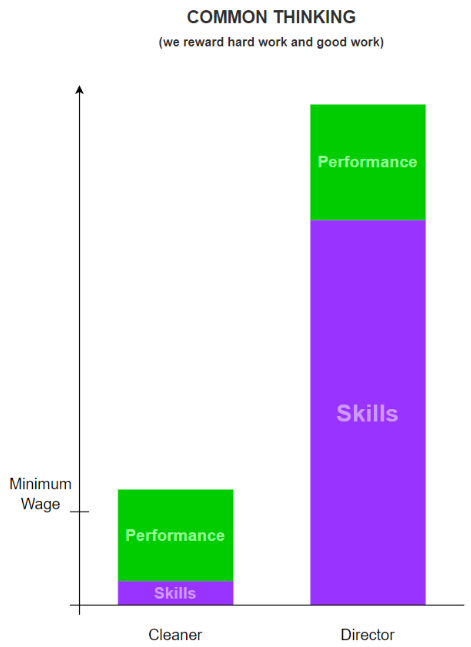
If this were true we would see a wide salary range for all jobs, with workers in each job being paid different salaries depending on their performance. Top performers in each role would earn far more than the workers who are performing badly. This is not the case.
Look at the lower and upper ends of the pay scale in a large organisation like a hospital.
Cleaners (formally called Domestic Service Assistants) come under band 2 in the NHS pay scale. All cleaners are paid the same salary, £22,383[2], regardless of performance.
Directors (formally called Director of Workforce) earn between £100’000 and £131’300[3], while Chief Executives earn between £190’000 and £260’000[3].
The reality is that salaries are almost entirely determined by the market rate for a particular skillset, with employees in a position of power also demanding a bonus.
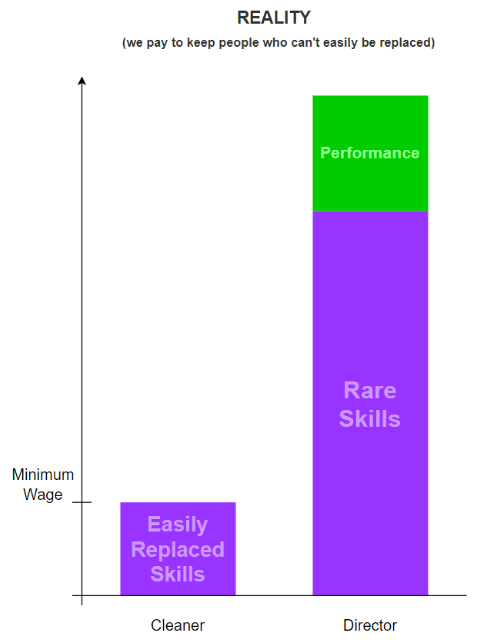
Employees with easily replaced skills cannot argue or bargain for a pay rise; pay stagnates in an economy where other salaries are climbing well above inflation. The overall effect being that the lowest paid are pushed further into poverty.
More importantly there is no performance-related pay for these roles either. It doesn't make business sense to not offer an incentive or reward to people who do their job well.
Workers in poorly paid jobs are expected to switch to a better-paid career. There is an assumption that people choose a career based on money. That is not the key motivation for all people when choosing a profession.
Take nursing as an example - a skilled profession but relatively low paid. In 2022, while negotiating a £1400 pay rise for nurses, the UK government suggested nurses struggling with the cost of living could increase their salary further by working overtime or getting promoted.
Unless you are familiar with NHS pay bands you may not know that each band has a minimum and maximum salary. A newly qualified nurse enters at band 5 with a starting salary of £25’655[4] and an upper limit of £31’534[4]. Promotion to band 6 comes with the responsibility of leadership and an upper salary limit of £39’027[4]. These are hard limits which apply regardless of a person’s experience or abilities. A further increase in salary is not possible unless the nurse moves into management, away from front-line nursing.
Telling a front-line nurse to move into management if they want a pay rise shows a lack of understanding about business. A team needs good people at all levels of its operations. Encouraging all workers in an under-paid role to hand in their notice would create a catastrophic personnel shift that unbalances the team.
Applying narrow salary limits to specific careers has an impact on social inequalities such as race inequality and the gender pay gap.
It’s a sad fact that jobs typically done by women are lower paid than jobs typically done by men. The cause is well known: historically men were the family bread winners and got paid far more than women who worked for pin money that bolstered the family’s income. It has been over a hundred years since women took up jobs at factories that would have otherwise been dormant during the first world war. Yet, a century later, we still haven’t eradicated the gender pay gap.[5]
The accepted answer to the gender pay gap has been to put more women in high power roles. This is the pitch from feminist groups who want to see more women in those high-earning roles because it will balance the average. However, while this gives a big boost to the few women who enter those powerful positions, it does nothing to help the majority.
Telling women "there are better paid jobs if you consider a career change" is an approach that translates to “women need to take their careers more seriously”. They already do! They’ve just chosen a career that isn’t centred around money.
No one should need to switch careers to get paid a living wage.[6]
Summary
The gender pay gap is a major contributing factor to poverty - particularly child poverty. You cannot attempt to tackle poverty while ignoring the gender pay gap. We can start by rewarding the contribution of people who are dedicated to a role, not just the career climbers.
If reducing poverty is not sufficient motivation, take a more Machiavellian viewpoint: the desire to see better performance in all areas of the workforce.
We want our hospitals to be well run, but we pay directors six-figure salaries whether they run the hospital well or not.
We want our hospitals to be clean, but we pay cleaners minimum wage whether they clean the hospital well or not.
Our approach to pay is absurd.
I’m not suggesting these roles should have overlapping or similar salary bands; not even that their salaries should fall in the same ballpark. I am saying that we must stop pretending that the salary structure we currently use rewards good work, or is in any way related to performance.
Managers will know that performance-related pay is difficult to implement at the bottom end of the pay scale. The minimum wage prevents any pay reduction for staff who perform poorly. However, performance-related pay can be introduced for people on low wages if we ensure everyone is paid for their time and, in addition to this base salary, there is a (small but significant) bonus for good performance.
[1]
From the 2014 Nationwide Annual Report to Members:
“... the Committee has determined that base salaries [for board members] will be increased to take account of the reduced levels of performance pay”.
One example of a company taking pity on their wealthiest employees when times get tough.
[2]
Salary data for domestic assistants taken from the financial year 2023/24. Mean and max salary data provided by 3 trusts confirmed that performance related pay was paid:
Barts Health NHS Trust FOI-23-1404
University Hospitals Birmingham NHS Trust FOI 3867 2023/24
Manchester University NHS Trust FOI 0250-24
[3]
Salary data for directors taken from the financial year 2022 - the most recent data available at the time of writing.
The dataset has since been truncated; I have a copy of the original, complete file.
[4]
Salary data for nursing taken from the financial year 2021/22 - the time of the post-covid pay rise negotiations which made headlines. It’s not possible to compare these salaries to domestic assistants and directors without taking inflation into account.
[5]
The gender pay gap in 2024 is 13.1%. The gap was 27.5% in 1997 - it has taken almost 30 years to halve the gap.
[6]
I’m not suggesting the top salary of every career should fall inside the upper 10th or 20th percentile. The aim is a salary that pays enough to cover the household bills for a small family.