| In the barriers section of this series about poverty we look at problems with our approach to tackling poverty. |
Whether you regularly give to charity or are staunchly skeptical about their honourable intentions, you cannot deny that our society functions through charity. From food banks to hospices and national helplines for victims of abuse; there are essential parts of our society that rely on philanthropy.
The inconvenient truth is that charity is a symptom of a broken society - specifically, a broken system of cash-flow.
Anecdote
In the spring of 1990 dad’s car failed its MOT. It was going to cost £300 to repair.
It wasn’t a huge sum of money but it was beyond what my dad could take on his credit card and larger than his overdraft would allow. My dad needed a loan.
In those days taking out a loan wasn’t as simple as filling in a form. You had to take a half-day off work, put on your best suit and go for an interview with the bank manager. The bank would ask why you need the money, check your income and out-goings and ask how quickly you intend to pay the money back.
Dad’s interview did not go well. It wasn’t the amount of money that posed the problem, it was dad’s job in the car industry which was in serious decline. The bank manager thought dad would be out of work before he could pay back the loan.
The loan was refused. Dad scrapped his car.
The bank’s attitude never made sense to me. If dad was going to be out of work, having a car would give him more opportunity to find another job. The loan would represent investment in a hard-working man who wants to contribute.
Times changed before the end of that decade. What now seems like an out-dated process of getting a loan was replaced by pay-day loans and extended limits on credit cards. Getting into debt became easier, which ultimately led to the financial crisis of 2008 and beyond.
Instead of loaning more money for the right reasons to people who need it, we loaned more money for any reason to people who wanted it. The money went to supplement disposable income.
Discussion
Charity has always been used (and should continue) to provide funding to the arts, student scholarships and supporting people in unfortunate circumstances. These are not the charities I want to discuss here.
While the role of charity is fuzzy and subjective, what cannot be debated is the fact this blurred line has led to the gradual change in scope. We now rely on charity to fund essential public services like hospices, hospital services and school equipment.
Getting money to people who need it most is a difficult problem to tackle. It should not be left to chance. Essential services cannot rely on the hope of adequate funding.
Most people would be offended by the idea of asking a borrower how they intend to spend the loaned money. This would be intrusive and patronising. Yet the same people would give money to charity - a system of funding that restricts and controls how that money is spent, ensuring a just cause.
Surely in the act of charity we have the right to demand how the money is spent - because we are giving the money away rather than lending it - but let’s look at charity another way.
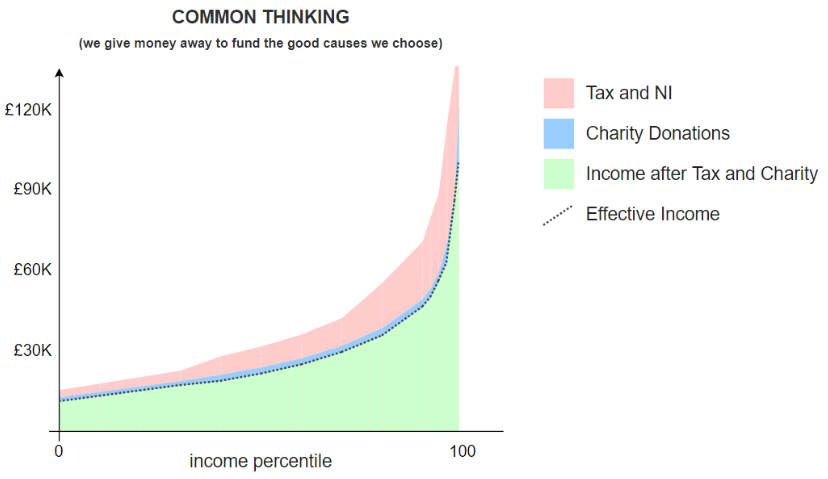
The graph above shows income across the population, from the lowest earners on the left to the highest earners on the right. The amount given away to charity is highlighted in blue. [1]
As discussed in “Rate of Pay”, poor people don’t want charity, they want to be paid a decent wage for their work. “Levelling up” does not mean everyone gets paid the same, it means everyone has a wage that at least supports a minimum living standard - “the living wage”.
What if we used our charitable donations - the money we can spare - to “level up” the lower end of the pay graph.
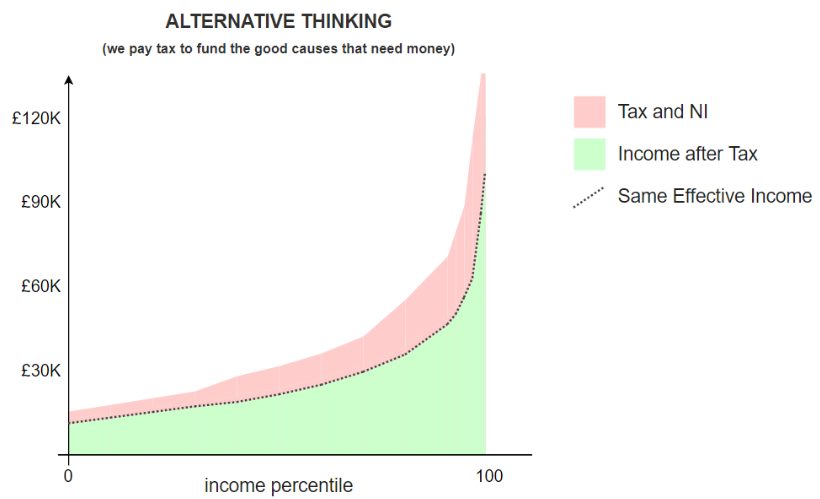
In this graph the charitable donations have been removed. This money would instead be collected through PAYE income tax and distributed to worthy causes. We have effectively replaced our spend on charity and increased our tax.[2]
To fund good causes there is no effective difference between giving money via charitable donations and distributing money collected through taxation. For some people there is a conceptual difference in controlling how their money is handed out - to feel a moral uplift because they gave their money away.[3]
Many refuse to trust governments to distribute wealth. However, it is pure arrogance to assume we as individuals would be more capable of distributing funds to worthy causes. Brian Eno eloquently sums this up in this interview.
In 2024 (latest CAF data for charitable giving) CAF reported 7% of charitable donations went to animal welfare, 4% to homelessness and refuges[4]. It is folly to argue that society values animals twice as much as fellow humans. These statistics are a result of chance, not design. No one checks these statistics to assess the balance of funding before giving to charity.
There is no better organisation than government to determine which worthy causes are in need of funding and which have surplus cash. Our trust in government fades because government fails to do its job well; this does not mean we need to bypass government; it means we need a better government.
Summary
Charity is a mechanism to redistribute wealth to those who need it. Whether you give to charity to support a good cause or for self gratification, the reason you have to give - the reason charities exist - is due to the broken distribution of wealth.
If you give to charity you must also be willing to fight against the imbalance in wealth. If you truly believe in the causes you support then you should be content to give that money away before you receive it.
Government is best-placed to distribute wealth but routinely fails due to a combination of corruption and incompetence.
Even if government was perfect, solving cash flow is only a first step. Problems such as poverty are not solved simply by transferring wealth, there are systemic issues to tackle. People in poverty are raised with different mindsets - their ambitions, strategies and tactics being stunted by low life-expectations set during childhood. Aside from money, they need support to overcome these non-financial challenges and learn relevant life skills.
This is how you would treat your neighbour. You would not insult them with charity. You would offer them advice, your time or borrow them your tools.
It’s time we stopped playing God and started being neighbourly.
[1]
This graph doesn’t show the 99% percentile - the top 1% are so wealthy we would not be able to see any detail in the other 99%.
The charitable amount is scaled by a factor of 5 to make it visible.
[2]
Not all charitable donations go to tackling poverty. Therefore, the amount of tax in the lowest percentiles has not been reduced to the extent you may expect when looking at the amount donated to charity in the first graph.
[3]
This control and superiority is the same process that black people refer to when talking of the “white saviour” mentality.
We could draw a similar graph of GDP by countries in order of wealth. Rich western countries rake in the most cash and make charitable donations to alleviate problems in poorer countries without actually tackling the root cause of those problems.
[4]
UK giving report 2025, page 12, figure 6