| In the barriers section of this series about poverty we look at problems with our approach to tackling poverty. |
Those who wear fine robes often judge people wearing rags by questioning whether they have worked hard.
Those who only have rags often judge people who have fine robes by questioning how they came by their luxuries.
What we wear is not a representation of our morals. Anyone, if given more money, would take the opportunity to pay for a better quality of life.
We all cut our cloth according to our means. When times are tough, we all tighten our belts and complain about having to do so. Before complaining it’s important to take a reality check, and note the quality of the cloth we are wearing.
Anecdote
I feel incredibly lucky to be where I am today. I have made many decisions that worked out incredibly well by chance. Other advantages I had no control over. The most significant of these is the year I was born, which serendipitously determined the year I left university.
I graduated from university in 1998. A few years earlier was the worst recession in two decades. I would have waited years to find a decent job, or any job for that matter. The following year, the student grant scheme ended and tuition fees were introduced. I would not have contemplated getting into debt for a university degree. I would have left school and gone straight into a job that paid minimum wage. I went to university at exactly the right time.
After sitting my final year exams I started looking for work. The careers fairs on campus had been and gone. Most graduates line up their first job months before they graduate. I didn’t know that. I was the first person in my extended family to go to university. No one I knew had even heard of a careers fair. Had I missed the boat?
I prepared my CV but had no idea what to do with it. My working class parents directed me to the job centre and the small ads in newspapers. Without help from the careers advisor at university I wouldn’t have even realised that I should be looking for a career, not a job. The advisor gave me a list of companies holding open days and told me to keep scouring newspapers.
One afternoon I sat in my bedroom writing covering letters to companies who had advertised in the local newspaper. My step dad came in to tell me some home truths.
“How are things going mate? Lots out there?“
“A few. Two more this week,” I told him.
“But no interviews?”
I didn’t reply. He knew I had been to an interview the previous week and that was the only one.
“Look,” he said, plucking the leaves of the open newspaper, “those kinds of jobs don’t go to people like us. You won’t get any luck applying for them. You’ve had your fun now, you’ve been to university, but now it’s time to knuckle down and get a job.”
I wanted to tell him I had a degree, a qualification, but the words wouldn’t come.
“Your mom said you’ve not paid housekeeping for two weeks now. There’s a job going in the newsagents on the square if you’re stuck for money.”
He didn’t give me a deadline but he made it clear that free lodging wasn’t forever.
He was right, of course, about the money. It wasn’t acceptable for me to expect bed and board for free. I wasn’t a child.
I was certain, though, that these jobs were in my grasp. University had not only taught me about software development, it had taught me much about myself. I had gained confidence in my abilities; I was certain I could do the job, even if I was uncertain whether my accent and postcode would bar me.
At my next visit to the job centre I gave my usual report showing the number of job applications I had sent, prospects lined up and interviews attended. I then asked about shop work. The advisor pulled out a file and rifled through the cards. “Perfect,” she said, “there’s a job going at PC World. It’s just across the road. You could go there now.”
It was the obvious fit. I don’t recall saying ‘yes’. She was already on the phone. Within a minute the call was done, and she was writing a name on a card. “Ask for this man. He’ll see you in half an hour.”
PC World was literally across the road, on the appropriately named “Battery Park”. I was there in minutes and, after announcing myself with the technician at the help desk, I killed time by browsing round the shop.
The store manager breezed towards me, smiling and offering a firm handshake. Everything looked promising. I felt confident I was a good candidate, he looked like a nice chap, what could possibly go wrong?
He waved a piece of paper in his hand and said, “I’ve just been reading your CV.”
I was stunned - I hadn’t sent it.
“The job centre just sent it over… so, is this you? A degree in computer science. What do you want to do with that?”
“I want to be a computer programmer,” I said.
“If I hire you today and next week you get a job offer as a programmer, what would you do?”
“Take the job as a programmer, of course.”
“So what’s the point in me hiring you, training you, devoting my time to you?”
I nodded in agreement. It was obvious.
“Don’t worry,” he continued, “the job centre sends lots of people over and I turn many away. Don’t take it the wrong way if I say I don’t want to waste an hour interviewing you.”
Thanks to his thoughtful words I didn’t leave feeling dejected. Although I did lament the non-interview; I could have benefited from the interview practice.
Several other attempts to find work at retailers and a bowling alley failed due to being over qualified. This was a stark change from when I was an undergraduate and easily found work as a cleaner. My degree was a pass into the middle class workspace.
In late September I secured my first white collar job. My starting salary in a middle-class desk job was £17’500. This was just above the UK average salary of £16’100.
I was aware this was more than my dad was earning as a senior tool setter with 25 years of experience. That struck me as odd but it was not unexpected. It was an indicator of how privileged I had become and I have never forgotten my position on the national pay scale.
Discussion
When the upper tax bracket is discussed there are a number of topics that inevitably arise.
First is the idea that you can’t force rich people to pay tax. Increasing tax on the wealthy will only cause them to squirrel their money away and find ways of tax avoidance.
This is a stereotype. True for some but not for all. Time and again tax revenues increase when the tax rate is raised. There is also a large community of patriotic millionaires who call for tax increases on the super rich. They see their country struggling to fund public-sector services and are happy to pay more tax as long as it leads to improved public services.
Second is the belief that the higher tax rate causes a person’s salary to go down as they pass a threshold into the next tax bracket.
This myth is perpetuated by high earners complaining about losing out due to an unfair tax system. It is just not true. Each tax bracket only applies to the money earned within that tax bracket.
E.g. a person earning £150’000 will pay 20% tax on the first £50’000, 40% on the next £75’000 and the top rate (45%) is only paid on the remaining £25’000.
National insurance contributions increase too, of course, but income tax does not cause a backwards jump in annual salary.
Finally, there is the complaint that the higher rate is too high. 80% of income tax comes from the richest 10% of people. This is true but the statistic only serves to highlight how wealthy the richest 10% are in comparison to the majority of people.
During the 2017 general election campaign Amber Rudd used this statistic to argue that the upper tax bracket should be abolished. It is seemingly unfair to ask the wealthy to give up a larger portion of their expendable income.
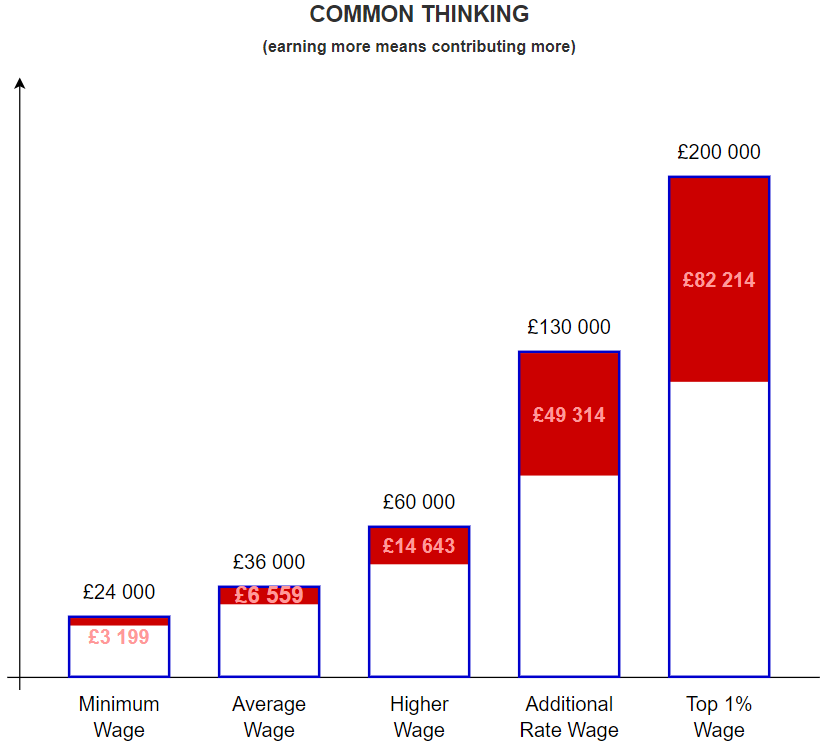
By focusing on the deductions (shown in red) people resent the heavy burden that comes with being wealthy. The shallow contribution by people earning minimum wage seems unfair and out of scale compared to the wealthiest. However, it doesn’t take into account that asking the poorest to contribute more would take their net income below the level needed to survive.
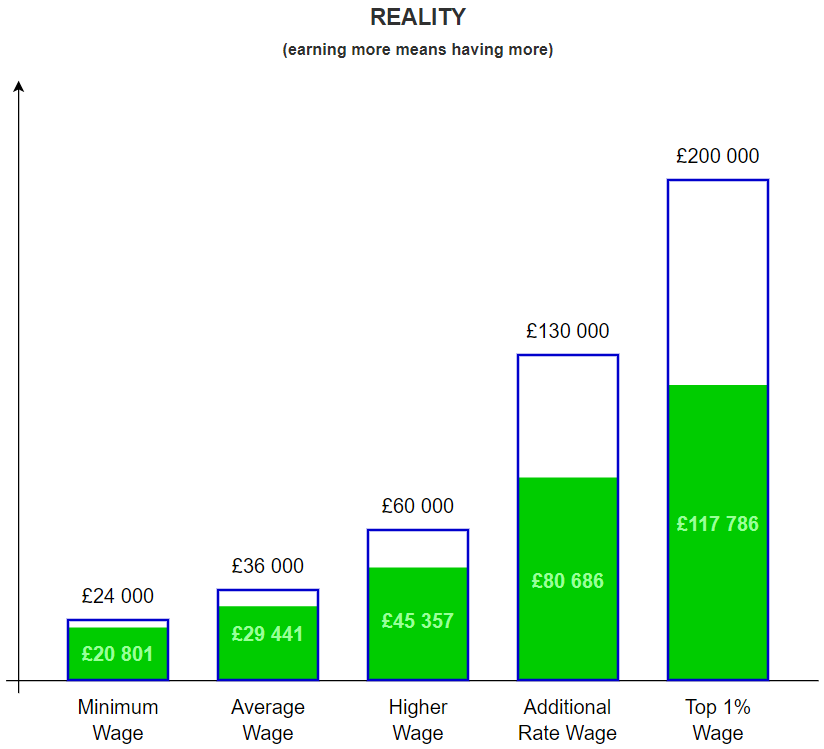
Instead we should focus on net income (shown in green).
Rather than the fear of losing a large sum of money we should appreciate what we have and how far we are from the poverty line.
Summary
With great wealth comes great responsibility. More pay should mean more tax. This does not mean tax is unfair; everyone pays 20% income tax on earnings below £50K. The income needed to maintain a good standard of living is taxed at the same rate regardless of how much expendable income you earn in addition to this.
The desire to keep more of ones money is not in any way evil; it is perfectly normal and rational. However, the corollary/outcome is to offload the burden to those who are less able to pay.
No one taking home £20K and paying £4K in tax would turn down the opportunity to take home £78K while forfeiting £47K in tax. Anyone outside the bubble of extreme wealth can see that the extra tax burden pales in comparison to the gain in personal wealth. From which I conclude that our society has made the wrong people rich.
Paying a larger percentage of tax on disposable income is a mere inconvenience in the step up to a better lifestyle.